About
Trained across three countries, focused on one question
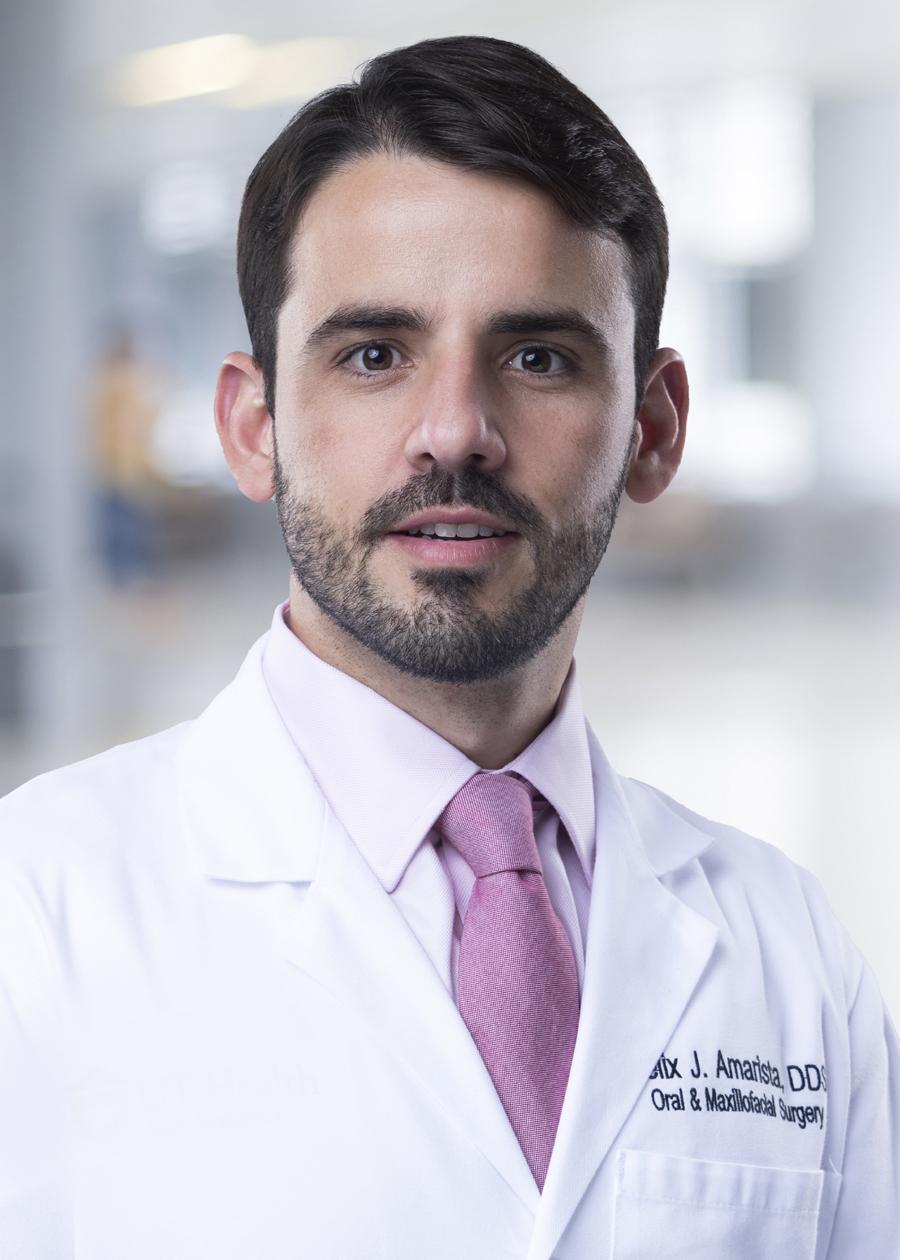
Felix J. Amarista, DDS, FACS is a board-certified oral and maxillofacial surgeon, Clinical Associate Professor and Associate Program Director in the Department of Oral and Maxillofacial Surgery at the James B. Edwards College of Dental Medicine, Medical University of South Carolina.
He trained in Venezuela, Colombia and the United States, through two full residencies in oral and maxillofacial surgery. The question that has organized his work since then is a narrow one: how much of a surgical plan actually survives the transfer into the operating room, and what makes the difference.
His clinical practice focuses on minimally invasive orthognathic surgery with patient-specific implants, and on surgical management of the temporomandibular joint, including arthroscopy and alloplastic total joint reconstruction. His research measures the accuracy of that transfer: splints versus patient-specific guides and plates, virtual versus physical model surgery, and the outcomes of total joint reconstruction.
Dr. Amarista is a reviewer for the Journal of Oral and Maxillofacial Surgery. He lectures and runs cadaver training courses internationally, in English and Spanish, and teaches residents as Associate Program Director.
Training
- Caracas, Venezuela
Doctor of Dental Surgery
Universidad Central de Venezuela
- Bogotá, Colombia
First OMFS residency and master's degree
Universidad Militar Nueva Granada and Hospital Militar Central. Best resident across all surgical specialties; researcher of the year twice.
- San Antonio, Texas
Second OMFS residency, chief resident
UT Health San Antonio, where he stayed on as faculty for five years.
- Charleston, South Carolina
Clinical Associate Professor, Associate Program Director
Medical University of South Carolina
Approach
Nothing about technique is self-evident.
He trained twice, in two different systems, as a consequence of moving countries rather than by design. The repetition had one lasting effect: what is taught as standard in one place is contested in another, and the difference is rarely settled by authority.
That disposition is what his research is made of. He is less interested in advocating for minimally invasive surgery than in quantifying what it improves, by how much, and where it does not. Each completed case is reviewed against the plan afterwards, independently of how satisfied the patient is, and the discrepancies are what end up in the literature.
The same applies to how he teaches. The courses he leads are organized around the errors of the transition from conventional to minimally invasive technique, his own included.
Recognition
- 2025AAOMS Faculty Educator Development Award
- 2023IAOMS NextGen Outstanding Young Surgeon Award
- 2023Daniel M. Laskin Award, best manuscript published in the Journal of Oral and Maxillofacial Surgery in 2022
- 2018Dr. Mario Scarrone Award, best Latin American resident (ALACIBU)
Credentials
- Board certification
- Diplomate, American Board of Oral and Maxillofacial Surgery, 2023
- Fellowship
- Fellow, American College of Surgeons, 2025
- Licensure
- South Carolina, Texas, Florida
- Memberships
- AAOMS, IAOMS, ACOMS, ASTMJS, American College of Surgeons